1
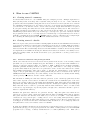
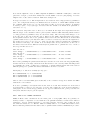
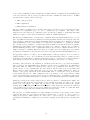
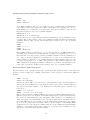
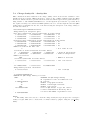
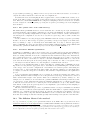
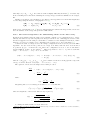
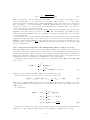
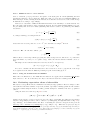
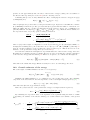
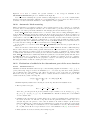
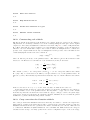
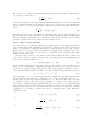
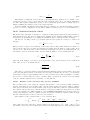
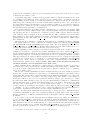
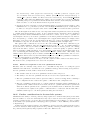
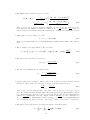
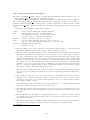
the nucleus. The electric field acting on a given ion core at RI due to the other ion cores at RJ and the electrons at ri is FI = − X ZJ J6=I X riI RJI + , |RJI |3 |riI |3 i (134) where RJI = RJ − RI and riI = ri − RI . The CPP energy is then VCPP = − 1X αI FI · FI , 2 (135) I where αI is the dipole polarizability of core I. Eq. 134 assumes a classical description which is valid when the valence electrons are far from the core. When a valence electron penetrates the core the classical result is a very poor approximation, diverging at the nucleus. To remove this unphysical behaviour each contribution to the electric field in Eq. 134 is multiplied by a cutoff function f (riI /r̄I ), which tends to unity at large riI . A further 4 ), possible modification is to allow the one-electron term in Eq. 135, which takes the form −αI /(2riI to depend on the angular momentum component, l, so that r̄I in the cutoff function is replaced by r̄lI . With these modifications the CPP energy operator becomes VCPP 2 X X riI · rjI riI rjI riI 1 X X 1 X f P̂l + αI f =− 4 3 r3 f 2 riI r̄lI riI r̄I r̄I jI i i j6=i I l 2 X X riI · RJI riI X RJI f −2 ZJ + , 3 R3 3 ZJ r r̄ R I iI JI JI i J6=I (136) J6=I where P̂l is the projector onto the lth angular momentum component of the ith electron with respect to the Ith ion. We use the cutoff function [31, 32], 2 2 f (x) = 1 − e−x . (137) For efficient evaluation, Eq. 136 is written as VCPP " 2 # lmx 2 X X 1 X r 1X 1 riI iI f =− αI |F̄I |2 + αI −f P̂l , 4 2 2 r r̄ r̄lI I iI i I I (138) l=0 where F̄I = − X J6=I X riI RJI ZJ + f |RJI |3 |riI |3 i riI r̄I , (139) and the maximum angular momentum is lmx = 2. In our approach the cutoff parameter for all angular momenta l > 2 is r̄I , which is slightly different from Shirley and Martin [32] who use r̄2I . 10.19.1 Implementation of CPPs in molecules and solids Eq. 138 contains 5 parameters for each ion, αI , r̄0I , r̄1I , r̄2I and r̄I , whose values are entered at the end of the xx pp.data file, see Section 7.3. Suitable values of the parameters are given in the paper by Shirley and Martin.[32] If r̄0I = r̄1I = r̄2I = r̄I , the second term in Eq. 138 is zero and it is not calculated. The second term in Eq. 138 is short-ranged because f (x) → 1 at large x. This term is calculated in real space. The second term in Eq. 138 is added to the pseudopotential and the core radii LCUTOFFTOL and NLCUTOFFTOL are determined from the resulting potential. The electric field evaluation is 86