1
circuitcellar.com
75
TEST YOUR EQ
Contributed by David Tweed
ANSWER 1
The first function, test_pressure(),
converts the ADC reading to engineering units
before making the threshold comparison. This is a
direct, obvious way to implement such a function.
The second function, test_pressure2(),
converts the threshold value to an equivalent
ADC reading, so that the two can be compared
directly.
The key difference is in performance. The
first function requires that arithmetic be
done on each reading before making the
comparison. However, the calculations in
the second function can all be performed at
compile time, which means that the only runtime operation is the comparison itself.
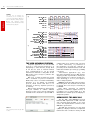
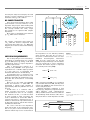
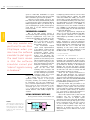
The output F is simply the
inversion of input C. The output JK is
high only when A is high or D is low.
The output LM is high except when B
is low and C is high. Therefore, the
entire function can be realized with
a total of five gates (see Figure 1).
ANSWER 3
The original 10-Mbps Ethernet
standard was jointly developed
by Digital Equipment Corp. (DEC),
Intel, and Xerox. It was released in
November 1980, and was commonly
referred to as “DIX Ethernet.”
ANSWER 4
The multiple access with collision
detection protocol that Ethernet
uses was based on a radio protocol
developed at the University of
Hawaii. It was known as the “ALOHA
protocol.”
ANSWER 2
FIGURE 1
How many NAND gates would it take
to implement Problem 2’s transition
table?
What’s your EQ? The answers are posted at
circuitcellar.com/eq.
You
can
contact
the
quizmasters at eq@circuitcellar.com.
NETWORKING
engineering
DISCUSS
information
social media
design tips tutorial software
engage
talk
tools
engineering
system
audio business
product newsmedia
electronics COMMUNITY
projects data embedded
Want to talk to us directly?
Share your interests and opinions!
Check out our New Social Media Outlets for direct engagement!
CIRCUIT CELLAR / AUDIOXPRESS / ELEKTOR
TESTS & CHALLENGES
First of all, note that there are really only
four inputs and three unique outputs for this
function, since input E is always 1 and outputs
GHI are always 0. The only real outputs are F,
plus the groups JK and LM.
Since the other 27 input combinations
haven’t been specified, we can take the output
values associated with all of them as “don’t
care.”