1
Ref. 1038/13
SINTHESI CALL MODULE WITH DIRECTORY Ref. 1038/13
PROGRAMMING
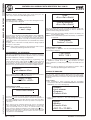
6) Duration of call ring
Indicates the duration of the call ring on the indoor set. It
is advisable to program the same value on all call stations.
Permissible values (in seconds) range from 1 to 5.
7) Number of voice lines
The number of voice lines (including Main and Secondary) in
the system must be specified.
Settable values are ‘1’ and ‘2’.
8) Buzzer Sound Level
The intensity of the acoustic signals (key pressed, call
forwarded, end of conversation beeps, etc.) can be adjusted
to 3 possible levels: Minimum (Min), Medium (Med), Maximum
(Max).
9) Code associated to Key T1
In the case of combination with a Ref. 1145/11 or -/12 module,
the code associated to pressing of the first key must be
specified.
If this key is to send a call to a specific Main Entrance
Switchboard - both during the day and night but not when
off – program the indoor set code of the Main Entrance
Switchboard.
If the key is to send a call to any switchboard present that is in
‘day A’ condition, program ‘0000’.
Programmable codes are between ‘0000’ and ‘JJJJ’.
10) Code associated to Key T2
This is the code associated to the second key of any
Ref. 1145/12 module.
Programmable codes range from ‘0000’ to ‘JJJJ’.
11) Saving of the Configuration Access Password and
(automatically) of the lock release code programming
password.
The password must be numeric ONLY and must consists of 4
digits.
The password programmed in this way can then be used
to access module configuration without having to open the
Sinthesi frame.
Programming of the configuration access password
automatically enables a second password that can be used to
program name and lock release codes. This second password
is derived from the first with an increment of 1. If, for example,
‘1234’ has been programmed, the name and lock release code
programming password will be ‘1235’.
The installation technician can therefore reveal to others
(system administrator, porter etc.) ONLY the name and lock
release code programming password avoiding any risk of
access also to configuration parameters.
The values that can be programmed range from 0001 to
9998.
DIGIVOICE - Technical Manual
USING
THE
Ref.
1038/56
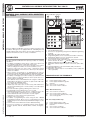
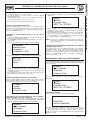
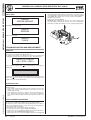
Programming using the terminal must be carried out with the system
on.
• Switch on the terminal holding down the ‘ON’ key for at least 3
seconds.
• Insert the programming cable in the specific outlet (2) or alternatively – on another call Module, Main Entrance Switchboard
or Passive Plug. The terminal will be connected automatically to the
data line and the following message will be shown on the display for
3 seconds:
Programming
and then:
Find:
<Serial Number>
<Type>
<Acquisition>
SINTHESI CALL MODULE WITH DIRECTORY
5) Door open time
Indicates the time (in seconds) of duration of the electric
lock maintenance current. WARNING: when locks that do
not require latching current are used, ALWAYS set the lock
release time to zero.
In the case of low absorption locks ONLY, the door open time
can be set between 1 and 30 seconds.
PROGRAMMING
TERMINAL
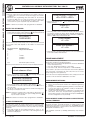
• Select the <Serial Number> option.
The following message is displayed:
Serial number:
000000
Enter the serial number of the Call Module (given on the rear label
(10) at the S/N item), and press ↵ key. The following message is
displayed:
REP SN: uvwxyz
--------------Road . . . . . . . . . . . . .
At this point, the terminal is connected logically with the Call Module
with Repertory (REP) with the selected serial number (‘uvwxyz’). To
indicate that the module is in Maintenance status, the display of the
module will show:
MAINTENANCE
Please wait
NOTE: the module permits management of the electric lock also in
‘Maintenance’ status, both following entry of a lock release
code and activation of the main entrance button or of the
postman key contact.
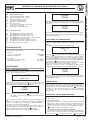
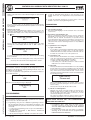
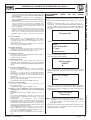
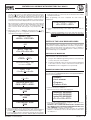
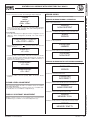
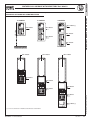
• At this point, the following can be programmed: the description of the
installation site, the 11 configuration parameters and the operating
language divided into four pages:
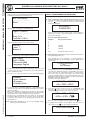
sec.2a −−−− 5
SINTHESI CALL MODULE
• In systems with at least one secondary call station, the main
call station(s) must be programmed with LOCK RELEASE
WITH SECRECY.
The secondary call station(s) can be programmed as
required with FREE LOCK RELEASE OR LOCK RELEASE
WITH SECRECY.
In the first case, after a call from the main station, activation
of the lock release key on the indoor set called will cause
opening of the lock connected to the main call station and
of the lock connected to the secondary station on which that
indoor set depends.
In the second case, following a call from the main station,
activation of the lock release key on the indoor set called
will cause opening of the lock connected to the main calling
station only; a second call must then be made from the
secondary station in order to open the lock connected to
this.