1
Power Generation Facilities Design Guide
VESDA by Xtralis
4
Environmental Condition Considerations
4.1
High Background Pollution
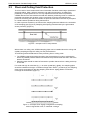
In areas that exhibit extremely high levels of airborne particulate matter (coal dust, lint, etc.),
we recommend the inclusion of in line filtering (pre-filtration) as part of the VESDA system
design. Filters (such as E700-FILASSY) are placed, external to the detector, in the sampling
pipe network to collect the particulate matter before the air sample enters the detector.
In-line filtering also helps to extend the life of the on-board VESDA filter. For detailed
information on in line filtering, please refer to Xtralis Application Note, In-line Filter for Harsh
[8]
and Dirty Environments (Document Number 10856 ).
4.2
High Temperature Environments
For optimum operation, VESDA detectors MUST be installed in a location where the ambient
[9]
temperature is within the normal operating temperature range of the units . High
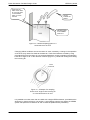
temperature sampled air can be easily cooled down, before it reaches the detector, by
extending the sample pipe length beyond its point of exit from the protected area. The
relatively cooler air outside the pipe near the detector will cool the warm sampled air within it.
Usually, only a short pipe extension is necessary.
40
12
40 L/min
35
10
30
PVC Pipe Length (ft)
PVC Pipe Length (m)
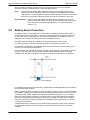
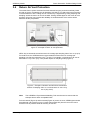
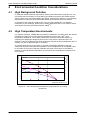
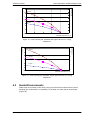
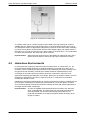
The charts below (Figure 15 to Figure 17) provide conservative estimates of the pipe
extensions required to decrease the temperature of the sampled air to an acceptable value
for a number of commonly used pipe materials and range of flow rates. All calculations
assume an external ambient temperature of 20°C (68°F) and a sampled air temperature of
60°C (140°F).
8
30 L/min
25
6
20
20 L/min
15
4
10
2
5
0
100 / 212
0
90 / 194
80 / 176
70 / 158
60 / 140
Sampled Air Temperature (°C / °F)
Figure 15 – Chart showing the estimated PVC pipe extension for cooling
sampled air.
16
Doc. 14158_02