1
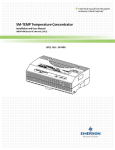
SM-TEMP Temperature Concentrator
Installation and User Manual, UM547490 (Issue AG, September 24, 2013)
Environmental
Description
This document provides specification, installation, and
operational information for the SM TEMP Temperature
Concentrator that is designed for use in both -48V and +24V
systems.
NetSure™ Power Systems can be operated in conjunction with
one or more battery and/or ambient temperature probes. With a
battery probe installed and connected, the power system is
designed to automatically increase or decrease output voltage as
battery temperature decreases or increases, respectively. This
maintains an optimum charge voltage to the battery with respect
to temperature, thereby extending battery life.
•
Operating Ambient Temperature Range: -40°C to
+70°C (-40°F to +149°F)
•
Temperature Measurement Range: -25°C to +105°C (13°F to +221°F)
•
Storage Ambient Temperature Range: -40°C to +85°C
(-40°F to +185°F)
•
Humidity: Capable of operating in an ambient relative
humidity range of 0% to 95%, non-condensing
•
Altitude: Will operate at any elevation between sea
level and 10,000 ft.
Each SM TEMP module receives temperature inputs from up to 8
solid-state temperature sensors (AD592B type). These are the
same temperature sensors currently connected to the
temperature inputs of the SCU, SCU+, ACU, and ACU+ controllers.
Accessories
The SM TEMP module provides a 125 kbps CAN output of the
temperature of all connected sensors. There are address DIP
switches to allow up to eight (8) SM-TEMP modules to operate
concurrently on the same CAN bus.
Battery Temperature Probes
The SM TEMP module provides an analog output of the average or
the maximum (DIP switch configurable) of the temperatures of
the connected sensors. The output is a current source providing 1
μA/K. The output is compatible with the temperature port input
of the SCU, SCU+, ACU, and ACU+ controllers. When multiple SM
TEMP modules are used, the analog output of only one of the SM
TEMP modules is connected to the controller’s temperature port
input.
When used with an ACU+ (version 3.02 or later), in lieu of
connecting the analog output of the SM TEMP module to an ACU+
temperature port input, the SM TEMP module can simply be
connected at the end of the ACU+ CAN bus. Via the CAN bus, the
ACU+ reads each temperature probe from each SM TEMP module.
Specifications
Electrical
•
Input Voltage: ±18-60 volts DC
•
Input Current: 0.1 Amps
•
Input Protection: Internal 3 ampere fuse, not user
replaceable. An external 1-1/3 ampere fuse should be
user-provided in the ungrounded input conductor.
Spec. No: 547490
Note: This information is provided for reference. Refer to power
system documentation when ordering these accessories.
Temperature probe kits are ordered separately.
3.3 meter – P/N 556155
10.3 meter – P/N 552992
Optional Temperature Probes
Features
Up to two (2) temperature probes can be connected to the IB2
(ACU+ Interface Board). Up to two (2) additional temperature
probes can be connected to the optional EIB (ACU+ Extended
Interface Board). Any combination of the four (4) temperature
probes can be programmed to monitor ambient temperature
and/or battery temperature. In addition, the SM-TEMP can be
cascaded up to (8) units, connecting up to (64) additional
temperature probes. In total, a maximum of (68) probes can be
connected via ACU+ monitoring. A temperature probe set to
monitor battery temperature can also be used for the rectifier
battery charge temperature compensation feature, or the battery
charge temperature compensation feature can be programmed
to use the average or highest value of all battery temperature
probes.
The battery charge temperature compensation feature allows the
controller to automatically increase or decrease the output
voltage of the system to maintain battery float current as battery
temperature decreases or increases, respectively. Battery life can
be extended when an optimum charge voltage to the battery with
respect to temperature is maintained. A temperature probe set to
monitor battery temperature can also be used for the BTRM
(Battery Thermal Runaway Management) feature. The BTRM
[1 of 13]
UM547490
Issue AG, September 24, 2013