1
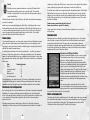
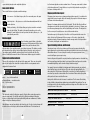
• green rotating triangles mark completed objectives
shell and armor depends on various random factors. The average armor value is shown
on the information panel. If armor thickness is equal to shell penetration capacity, then
the chance of damage will be 1/2.
Game control buttons
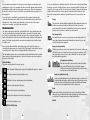
Three control buttons are placed around the minimap:
Weapon specifications (specs)
<Esc>-menu — this button brings up the <Esc>-menu and pauses the game
Latest objective — this gives access to the information window and the last
issued objectives
Marker positioning — this button allows you to place a marker in a network
game by right-clicking. The marker is shown with expanding circles on the
minimap. Its main function is to mark a position (for attack, defense, etc…) for
your network game allies
Aviation support
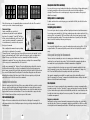
A set of aviation support buttons is placed in
the lower part of the game panel if the air units
available in this particular mission (if the
effective radius of your aviation squads covers the mission area). The buttons correlate
with the aviation types: fighter, bomber-fighter, bomber, helicopter, carrier, and scout.
The aviation support availability indicator (aircraft icon) is placed to the left of the
buttons. It indicates the amount of time left before more aviation support is available.
Combat unit condition indicators
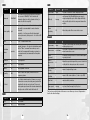
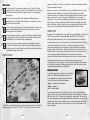
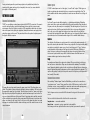
There are five colored bars in the right part of the game panel. These are color-coded
and also, the length of the colored bar correlates with the current parameter value
compared to the normal Level.
Damage level
(health)
Main ammo lot
or resources
Additional
ammo lot
Fuel
Current
experience
green — close to the normal level
yellow and brown — moderate values
red — for low values.
All weapons have two main specs: damage and penetration capacity. If a combat unit is
equipped with several weapons (tanks for example), the properties of the main weapon
are shown on the information panel.
Damage is the damage dealt on an object (in hit points). This will affect the health level
of manpower units and the structural points of equipment (or structures). Weapon specs
describe average damage values, while actual damage can fluctuate. This depends on
the fire accuracy in the and also on a series of other random factors.
Penetration capacity is the capacity of a bullet or a shell to penetrate the armor of an
object. An object will be damaged if it has no armor or if its value is lower than the
penetration capacity. Weapon parameters show the average value. Actual penetration
can fluctuate, and depends on random factors.
Types of shooting, radiuses, and fire zones
Ordering your troops to fire at a certain area will increase long-range shooting. Any
target appearing in a certain radius around that spot (within the shoot-in area) can be hit
with minimum misses. Of course, doing this reveals your long-range cannon to any
acoustic intelligence your enemy is using.
Anti-aircraft guns with ground fire capacity have three length parameters: short and long
radii for ground targets and short radius for air targets. Anti-aircraft guns also consider
the maximal height they can fire at when firing at an airborne target.
The cannon’s fire zone is defined by its aiming angle. Infantry, armored cars, and antiaircraft artillery have a circular fire zone. They can select any target within the fire
radius when alert. The fire zone of filed artillery is restricted, so it will be disabled for
some time if you need to re-aim outside of the current zone. Entrenched self-propelled
artillery units also have a restricted fire zone.
Object parameters
Infantry in the field has circular fire zones for small arms. The fire zone of the infantry
inside a building is dependent on window views and available firing positions. You can
view firing zones by selecting a building, and then selecting one of the soldier icons from
the top left corner of the screen.
Armor
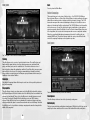
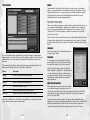
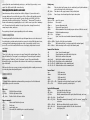
Maximal and minimal point-blank fire radiuses
Red circles
This represents an object’s defensive capacity. Objects with no protective properties
have zero armor value. If a shell hits an object, it will take no damage if the armor
thickness is higher than the shell penetration ability (with some randomness). Soldiers
within the object are likewise protected.
Maximal and minimal ballistic fire radiuses
Green circles
Object defense can vary from front to side to back to roof. As a rule, structural armor will
be similar for the entire object, while unit armor will differ more. The interaction of a
42
Air target fire maximal radiuses
Point-blank fire zone
Red sector
Ballistic fire zone
Green sector
Blue circle
43