1
ABSTRACT
This is a two-part thesis.
Part 1 presents an approach for working towards the development of a standardized
artificial soiling method for laminated photovoltaic (PV) cells or mini-modules.
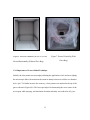
Construction of an artificial chamber to maintain controlled environmental conditions and
components/chemicals used in artificial soil formulation is briefly explained. Both poly-Si
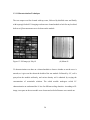
mini-modules and a single cell mono-Si coupons were soiled and characterization tests
such as I-V, reflectance and quantum efficiency (QE) were carried out on both soiled, and
cleaned coupons. From the results obtained, poly-Si mini-modules proved to be a good
measure of soil uniformity, as any non-uniformity present would not result in a smooth
curve during I-V measurements. The challenges faced while executing reflectance and QE
characterization tests on poly-Si due to smaller size cells was eliminated on the mono-Si
coupons with large cells to obtain highly repeatable measurements. This study indicates
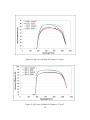
that the reflectance measurements between 600-700 nm wavelengths can be used as a direct
measure of soil density on the modules.
Part 2 determines the most dominant failure modes of field aged PV modules using
experimental data obtained in the field and statistical analysis, FMECA (Failure Mode,
Effect, and Criticality Analysis). The failure and degradation modes of about 744 poly-Si
glass/polymer frameless modules fielded for 18 years under the cold-dry climate of New
York was evaluated. Defect chart, degradation rates (both string and module levels) and
safety map were generated using the field measured data. A statistical reliability tool,
i