1
than that required to perform their functions) for administrator and operator roles. All actions
performed by privileged (and normal) users can be audited. The audit log is protected from
modification using integrity and subtype mechanisms. STOP™ also provides an alarm
mechanism to detect the accumulation of events that indicate an imminent violation of the
security policy.
STOP™ was designed from the ground up with strong internal architectural characteristics to
resist penetration and minimize the chance of bugs. STOP uses hardware privilege level and
memory protection mechanisms to protect itself from tampering and to isolate processes from
one another.
STOP™ consists of the TOE Security Functions (TSF) software and a body of untrusted
application code and commands. The TSF consists of the hardware and four major software
components:
•
The Security Kernel operates in the most privileged domain and provides all mandatory,
subtype, and a portion of the discretionary access control.
•
TSF System Services operates in the next-most-privileged domain, and implements a
hierarchical file system, supports user I/O, and implements the remaining discretionary
access control.
•
Operating System Services (OSS) operates in a less privileged domain and provides the
Linux-like interfaces.
•
Trusted Software operates in the lowest privileged domain and provides the remaining
security services and user commands.
The XTS-400™ is available on Intel Xeon (P4) based server class systems, available in tower,
and rack-mount chassis. All components are commercial-off-the-shelf (COTS). The XTS-400™
uses specific Intel-brand motherboards and industry standard ISA or PCI peripheral cards or
chips built into the motherboard.
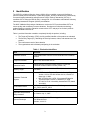
In addition to more basic components, the evaluated configuration allows:
•
•
•
•
•
•
•
•
•
CD-ROM drive
4mm DAT tape drive
PC card readers
Add-in Ethernet cards
Add-in SCSI host adapters
Parallel PCL-5 printer
Serial terminal
Touchpads
Flat panel displays
The validation team monitored the activities of the evaluation team, provided guidance on
technical issues and evaluation processes, reviewed successive versions of the Security Target,
reviewed selected evaluation evidence, reviewed test plans, reviewed intermediate evaluation
results (i.e., the Common Evaluation Methodology (CEM) work unit verdicts), and reviewed
successive versions of the ETR and test report.
The validation team determined that the evaluation team showed that the product satisfies all of
the functional and assurance requirements defined in the Security Target for an EAL 5
augmented with ALC_FLR.3 and ATE_IND.3 evaluation. Therefore the validation team
concludes that the Arca CCTL findings are accurate, and the conclusions justified.
2