1
USER MANUAL
1.
General information
1.1
BROEN BALLOMAX® Steel Ball Valves
The BROEN BALLOMAX® ball valve is intended for installation in District heating and
cooling networks operating with treated water not decomposing plain carbon steel
and materials in O-rings and seats.
The valve body is made of carbon steel and the shaft and the ball of stainless steel.
The ball seals are made of carbon reinforced Teflon (PTFE). The stem sealing is made
with FPM (Viton) and EPDM O-rings.
The valve is bi-directionally tight and can be installed in all positions.
1.2
Approvals
BROEN BALLOMAX® steel ball valves have been approved according to the
requirements of Pressure Equipment Directive (PED) 97/23/EC, module H. Module H
is the module for complete quality control.
1.3
Quality Management
BROEN A/S is a certified ISO 9001 company. The ISO certification is approved by
Bureau Veritas Quality International Ltd., London, one of the leading international
authorities on ISO certification. Bureau Veritas spent three days at BROEN to check if
our Quality Management system was adequate. BROEN spent an additional 12
months on analyses and discussions and made substantial investments to meet the
highest demands for quality management.
ISO 9001 is the hardest approval to achieve within the ISO 9000 standards. It fulfils
the requirements of EN29001 and BS 57, part 1, covering all processes of production
flow and customer service – from the very first product idea, through drawings,
materials, production as well as inspection and testing procedures, packaging,
shipping, staff training, contracts and technical documentation, maintenance and
claim handling.
2.
Preoperational Instructions and Precautions
Please read and note the following instructions before handling and operating the
BALLOMAX® ball valves:
• Check that the valve is suitable and approved for the medium and application in
question.
• Do not exceed temperature and pressure limits for the valve (see chapter 10).
Note: Not suitable for steam.
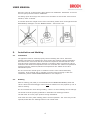
• Be aware. Valves installed at pipelines in operation can be hot. Be careful not to
get burned.
• In case the valve is used as an end stop valve at the pipeline, a closing cap or end
flange must be mounted after the valve, and the valve should be left in open
position.
2