1
FREQUENTLY ASKED QUESTIONS
Is this type of carrier safe for the development of my baby’s spine?
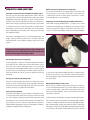
The basis of good posture begins with the pelvis. If this is well supported, the baby’s spine and neck will fall into a natural curve and the
weight will be supported by the pelvis. To ensure a correct position,
the baby’s knees should be higher than his pelvis, in a fetal position,
with his hips and legs properly supported. The baby’s bottom should
be lower than the knees and his back should be rounded with his
head resting on your body. This is the ideal position for the development of healthy hip joints. The baby does not hang, but comfortably
rests against the wearer.
Will the carrier put too much pressure on my breasts?
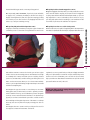
If you follow the instructions of our tying methods, the scarf should
not put pressure on your breasts. You should cross the bands over
or under them, and if across them, spread out the fabric so that it
doesn’t put pressure on one specific spot.
At what age can I start carrying my baby and when should I stop?
The benefits of carrying premature babies – or kangaroo care – is well
documented. A baby (full term or premature) can be placed in a baby
carrier just after birth, creating a ‘womb with a view’. There are, of
course, no problems starting later as well. Your back will strengthen
If the baby is in an upright position, it is essential that the legs do not
dangle or hang in mid-air. This puts strain on the baby’s spine and
the baby will tend to arch backwards creating a bad position for his
neck too.
The fetal tuck is the most natural position for a baby. Not only is this
position good for correct spinal and hip development, it allows him to
rest and use his energy to develop other strengths.
Does my baby’s head need to be supported?
If your baby’s pelvis is supported correctly as explained above, then
her neck will follow a natural curve and her head will rest on your
chest. She is free to lift her head when curious to look around and
her neck muscles will strengthen quickly. There is no need to support
her head, unless you are bending over. At that moment, spread one
band over her head. This can also be done to stabilize her when she
is sleeping.
How long can I safely carry my baby per day?
There are no limits. A baby well positioned in a baby carrier can be
carried as long as he and the wearer desire. Remember that babies
around the world are carried throughout the entire day as the wearer
continues about his or her daily tasks and activities.
Is this good for my own back?
If you have back problems, you should always consult with your doctor before using a baby carrier. This said, using a carrier is probably
one of the best ways to prevent back strain because the cloth carries
the weight and not your arms and back as when you are simply holding your baby in your arms. Carry your baby each day and progressively extend the carrying time to allow your back muscles a chance to
strengthen along with the baby’s weight gain.
as you carry your baby and his weight gains will go mostly unnoticed.
A baby can be carried as long as he wants. Even an older child will
find a safe refuge in a baby carrier when tired with the stimulations of
the outside world.
Will my baby like being in a baby carrier?
Babies crave close human contact. Once they are used to being carried, you will instinctively reach for your carrier whenever your baby
is fussy, can’t fall asleep, or just needs a reassuring presence. Some
babies need a little adaptation time to a new position in the carrier,
especially on your back.
Sometimes babies are unhappy in a carrier because they feel insecure.
This is often the result of not tying the carrier tight enough. Follow the
instructions carefully to make sure you wear your baby high and tight.
We recommend trying a new position when your baby is relaxed, just
after eating or ready to fall asleep. Walk around after placing your baby
in the carrier for the first time or when trying a new position. This will