1
Diamond Cut Live/Millennium Users Manual
Speech Filter
A filter which typically has a bandpass only between the frequencies of 300 Hz to 3 KHz, and which is used to improve the
basic intelligibility of speech. Often, this type of filter uses slopes of -12 dB / Octave.
This characteristic can be replicated with the Bandpass filter. An alternative speech filter that is sometimes useful is called the
Steep Slope Speech filter. Its response is 250 Hz to 3.5 KHz with a slope of 18 dB / Octave.
Spectrum
A band or range of frequencies as in the audio spectrum, the light spectrum, or the electromagnetic spectrum.
Spectrum Analyzer
A device for analyzing and displaying the Amplitude versus Frequency characteristic of a portion of a spectrum. They fall
into two general categories:
1. Swept Bandpass Filter (a serial process of analysis)
2. Real Time Analyzer (a parallel process of analysis)
Spectral Enhancer
An electronic device which is used to expand the dynamic range of the upper and/or the lower octaves of the audio frequency
spectrum, leaving the mid-band portion of the spectrum unprocessed. This has the effect of increasing the "definition" of a
recording without continuously amplifying hiss and rumble which may be present on the source material. It is a form of
dynamic filter which uses the principle of "upward expansion" to improve dynamic range. The Dynamic Noise Filter contains
a Spectral Enhancer mode of operation which can be enabled.
Stroboscope
A device which indicates the RPM speed of a turntable by creating an optical illusion of the slowing-down, freezing, or
speeding-up of a pattern when illuminated by a pulsating light source operating at a known frequency. You can create your
own stroboscope disc by dividing a circle evenly into black and white segments. Use the following formulae to calculate the
number of segments required per 360 degrees (1 rotation of the disc) into which the disc must be marked:
60 Hz power systems: # of segments = 7,200 / RPM*
50 Hz power systems: # of segments = 6,000 / RPM*
For example, assume that you want to construct a strobe for use in the United States where the power system operates at 60 Hz
in frequency. We want to design it “to freeze” at 78.2 RPM. 7,200 / 78.2 = 92.07. Round the number to 92 segments. Divide
your circle into 92 evenly spaced segments, and voila, you have your strobe. Because of the rounding error, the strobe you
constructed will be in error by 0.08 %. Your strobe will have to be used under a fluorescent or neon light connected to the
power line in order to function. Incandescent lamps will not work.
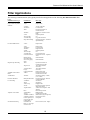
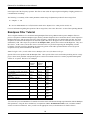
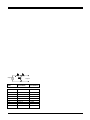
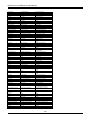
The following is a chart that you can use to create your own strobe using common line frequencies and RPM values:
RPM
# of Divisions for 50 Hz
# of Divisions for 60 Hz
16
375
450
33.33
180
216
45
133
160
78.26
77
92
80
75
90
*Note: Actually, two pulses of light are produced per cycle of the line. But, for improved visibility, it is better to use every
other pulse to light up the strobe.
Note: The DC Millennium/LIVE program provides two bitmaps that you can download and use as phonograph strobes
covering the important speeds.
Styli
The following is a listing of some of the more common record types and the styli that they require:
A. Modern LP's: 0.7 mil elliptical
B. Early LP's: 1.5 mil truncated elliptical
C. Transcription Recordings: 2.3 mil truncated elliptical
D. Narrow Groove 78's such as Polydor: 2.4 mil truncated elliptical
157