1
B. IMU outages
The IMU stopped delivering valid data for more than five hours six times during the past year. Both IMU-1 and
IMU-2 had three outages each. Two times a drop to Safe Mode followed because of low battery power due to the
ensuing attitude deviations. The problem could always be mitigated by commanding a power cycle (of the
hardware).
An IMU outage has severe consequences on the attitude control. There are two IMUs on-board, but they are
operated in cold redundancy. This means that a switch or a restart has to be commanded unless the data flow
resumes by itself. Until then the ACS will use a rotation rate derived from (in sequence of preference and/or
accuracy)
1. the star trackers,
2. Sun sensor and magnetometer data combined,
3. the magnetic field measurements,
4. Sun sensor data.
The rates as determined from the star tracker quaternions are just as accurate as the ones derived from the IMU. In
this case TET-1 fulfills the OOV requirements without any constraint. A combination of data from Sun and
magnetometer is the second best solution. The accuracy, however, is so much lower that experiments such as N15
are influenced negatively. In eclipse only the rotation rate derived from the magnetic field measurements is
available. The time derivative of all three components of the magnetic field vector can be determined. However, the
accuracy of each of the three axes is very different due to the orientation of the satellite with respect to the magnetic
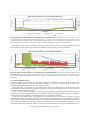
field. As a consequence the attitude errors can increase from 30° during phases with sunlight to 180° in eclipse (see
Figure 8).
The IMU outages could have two possible causes:
1. A freeze of the IMU
2. A link problem between IMU and ACS
Tests and analyses did not provide any exhaustive explanation for the outages.
Introducing an additional FDIR (Fault Detection, Isolation and Recovery) mechanism reduced the consequences
and operational effort necessary after an IMU outage. It simply switches the relay autonomously off and on again
when communication between ACS and IMU is interrupted (see chapter III-D).
1,2
200
1
100
0,8
0,6
0
0,4
-100
0,2
0
15:00
16:00
IMU NO COMP
17:00
18:00
Time [hh:ss]
SENDPUOK
Eclipse
19:00
Roll
-200
21:00
20:00
Pitch
Deviation to SPFM [°]
Status [0=off; 0,9=on; 1=on]
IMU outage on DOY12276
Yaw
Figure 8. Attitude deviations during one of the outages of IMU-1. Attitudeg deviations increased from 5′ to 180°
due to the outage. In this case the rates were determined from Sun sensor and magnetometer data. The noise is seen
to increase by a factor of 100 during eclipses where only magnetometer data can be used. In this instance there was
no information from the star trackers due to blinding and too high rotation rates of the satellite.
C. Loss of one RW
The increased operational load due to outages of reaction wheels and/or IMUs resulted in the loss of RW1 on the
222nd day of the mission. Since then TET-1 is flying with a three-wheel configuration.
g
Commanded attitude mode in this instance was SPFM with a bias of 30° in pitch.
8
SpaceOps 2014; Pasadena, California – May 05 - 09