1
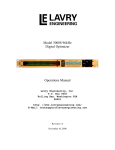
AD122-96 MKIII
Operations Manual
PART I: Introduction
The Model AD122-96 MKIII Mastering Quality Analog to Digital Converter receives analog input
signals at the left and right analog input channels. The converter can receive balanced or unbalanced
analog input signals. Individual left and right analog gain adjustment can be made via the front panel
adjustment pots. Fine tuning of reference levels can be achieved by setting the front panel bar graph
display (LED's) to “Fine” mode (reference meter bridge). The digital output is available at the AES/EBU
output. The AES/EBU XLR output is compatible with coaxial SPDIF using a simple adapter or adapter
cable.
Front panel selection enables setting word length between 16 and 24 bits (NI is a 20 bit setting as per
AES/EBU specifications). The recommended normal setting for word length is 22-24 bits (the audio
content utilizes 22 bits). Lower bit settings are aimed at redithering using the available αcoustic βit
Correction™ feature. Redithering to smaller words retains much of the acoustic information in the full
word width output.
The converter can operate with internal or external clock synchronization. Available internal crystal
frequencies are 44.1 kHz, 48 kHz, 88.2 kHz, or 96 kHz. For external synchronization, a signal is applied
to either the SYNC/WC XLR input or the Word Clock BNC input. The external synchronization
parameters are programmed into the converter according to desired frequency lock range and input type.
The input types are digital audio (AES/EBU) or word clock signals. The desired frequency lock range
settings are 44.1 kHz narrow lock range, 48 kHz narrow lock range, 40-50 kHz wide lock range, 88.2 kHz
narrow lock range, 96 kHz narrow lock range, 88/44 kHz, or 96/48 kHz (conversion rate 2X sync rate).
Vernier Transfer Function Correction™:
The exceptional performance of Lavry Engineering’s AD122-96 MKIII is due to design innovations in
both analog and digital sections. The high power consumption of the A/D modules, using high voltage
rails and high current, enables the use of discrete large geometry components. This provides advantages
from improved circuit architecture-- including class A amplifiers for fast settling and lower distortions, and
the use of low value resistors for lower noise.
The performance of the low-noise high-linearity converter is optimized by a set of proprietary algorithms
utilizing a "digital vernier" technique which provides superior resolution and correction for changes in
circuit parameters, including component drift due to temperature and aging.
Additional features:
Test Tones: a fully programmable digital test tone generator for calibration.
Polarity Inversion: changes polarity of digitized audio signal.
Soft Saturation: emulates analog tape saturation for higher recording levels.
User-Defined Power-Up Default Setting
Stereophonic Bar Graph Display: features wide dynamic range; the bar graph can be extended by 30, 60 or
90dB for viewing the noise floor. The bar graph may also be altered for use as a reference meter bridge.
Clip Indication: when digital full scale indication is enabled, the full scale “MAX” light can be set to hold
until reset by the user.
Format Control: pro or consumer data format. When in consumer mode the user can choose category,
C and L bit settings.
3