1
3.10. STOCHASTIC VOLATILITY MODELS FOR FINANCIAL TIME SERIES
3.10
33
Stochastic volatility models for financial time
series
Model description Stochastic volatility models are used in mathematical finance to
describe the evolution of asset returns, which typically exhibit changing variances over
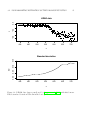
time. As an illustration we use a time series of daily pound/dollar exchange rates {zt }
from the period 01/10/81 to 28/6/85, previously analyzed by Harvey, Ruiz & Shephard
(1994). The series of interest are the daily mean-corrected returns {yt }, given by the
transformation
n
X
−1
yt = log zt − log zt−1 − n
(log zt − log zt−1 ) .
i=1
The stochastic volatility model allows the variance of yt to vary smoothly with time. This
is achieved by assuming that yt ∼ N (µ, σt2 ), where σt2 = exp (µx + xt ). The smoothly
varying component xt follows the autoregression
xt = βxt−1 + εt ,
εt ∼ N (0, σ 2 ).
The vector of hyper-parameters is for this model is thus (β, σ, µ, µx ).