1
CHAPTER 3. SOLUTION PROCESS
16
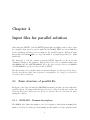
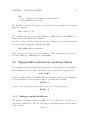
for each vector in the subspace and for each subspace iteration. The parallel subspace
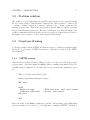
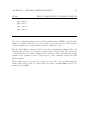
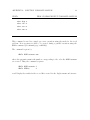
solution is performed using the command set
TANGent
MASS <LUMPed,CONSistent>
PSUBspace <print> nmodes <nadded>
where nmodes is the desired number of modes, nadded is the number of extra vectors
used to accelerate the convergence (default if maximum of nmodes and 8) and print
produces a print of the subspace projections of K and M. The accuracy of the computed eigenvalues is the maximum of 1.d − 12 and the value set by the TOL solution
command. The method may be used with either a lumped or a consistend mass matrix.
If it is desired to extract 10 eigenvectors with 8 added vectors and 20 iterations are
needed to converge to an acceptable error it is necessary to perform 360 solutions of the
linear equations. Thus, for large problems the method will be very time consuming.
3.3.2
Arnoldi/Lanczos method solutions
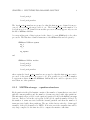
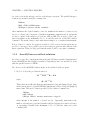
In order to reduce the computational effort the Arnoldi/Lanczos methods implemented
in the ARPACK module available from Rice University[12] has been modified to work
with the parallel version of FEAP.
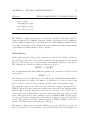
Two modes of the ARPACK solution methods are included in the program:
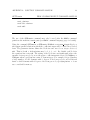
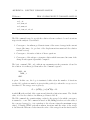
1. Mode 1: Solves the problem reformed as
M−1/2 K M−1/2 Ψ = Ψ Λ
where
Φ = M−1/2 Ψ
This form is most efficient when the mass matrix is diagonal (lumped) and, thus,
in the current release of parallel FEAP is implemented only for diagonal (lumped)
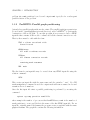
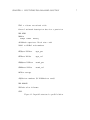
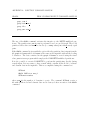
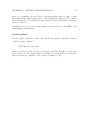
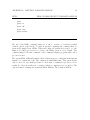
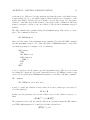
mass forms. This mode form is specified by the solution command set
TANGent
MASS LUMPed
PARPack LUMPed
nmodes <maxiters> <eigtol>
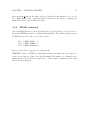
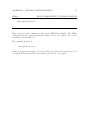
where nmodes is the number of desired modes. Optionally, maxiters is the
number of iterations to perform (default is 300) and eigtol the solution tolerance
on eigenvalues (default is the maximum of 1.d − 12 and the values set by the
command TOL.