1
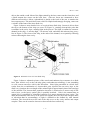
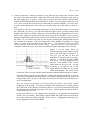
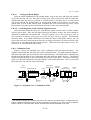
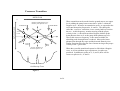
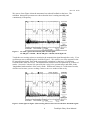
If the atoms in the vapor cell had a single excited state but two hyperfine ground states (we call them
both “ground” states because neither can decay via an allowed transition), and the separation of the ground
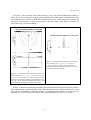
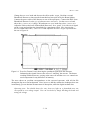
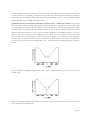
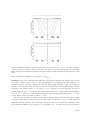
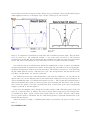
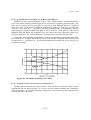
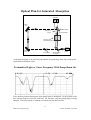
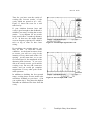
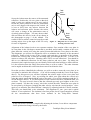
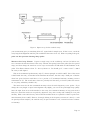
states was less than the Doppler width, then one might see a spectrum like in Figure 4. The extra cross-over
dip results from a phenomenon called “optical pumping,” which occurs because atoms in the excited state
can decay into either of the two stable ground states. Thus if atoms are initially in ground state g1, and
one shines in a laser that excites g1 → e, atoms will get excited from g1 → e over and over again until
they once spontaneously decay to g2, where they will stay. The state g2 is called a “dark state” in this
case, because atoms in g2 are not affected by the laser. We see that a laser exciting g1 → e will eventually
optically pump all the atoms into g2.
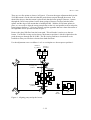
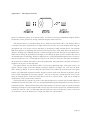
To see how optical pumping produces the extra crossover dip, remember that only the pump laser can
optically pump — the probe laser is by definition too weak. Also remember the atoms in the cell are not in
steady state. When they hit the walls they bounce off about equally distributed in both ground states, and
the optical pumping only operates for a short period of time as the atoms travel through the laser beams.
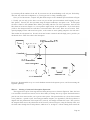
If you think about it a while you can see there are two velocity classes of atoms that are responsible for the
dip. For one velocity class the pump laser excites g1 → e, which tends to pump atoms into g2. Then the
probe laser, which excites g2 → e for these atoms, sees extra absorption. For the other velocity class the
pump laser excites g2 → e, g1 gets overpopulated, and again the probe laser (which now excites g1 → e for
these atoms) sees more absorption.
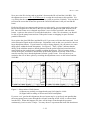
Quantitative Picture of Saturated Absorption Spectroscopy — 2-Level Atoms. One can fairly
easily write down the basic ideas needed to calculate a crude saturated absorption spectrum for 2-level
atoms, which demonstrates much of the underlying physics. The main features are: 1) the transmission of
the probe laser beam through the cell is e−τ (ν) , τ (ν) is the optical depth of the vapor; 2) the contribution
to τ (ν) from one velocity class of atoms is given by
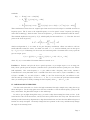
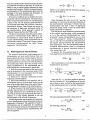
dτ (ν, v) ∼ (P1 − P2 )F (ν, v)dn(v)
where P1 is the relative population of the ground state, P2 is the relative population of the excited state
(P1 + P2 = 1),
dn ∼ e−mv
2
/2kT
dv
is the Boltzmann distribution (for v along the beam axis), and
Γ/2π
F (ν, v) =
(ν − ν 0 + ν 0 v/c)2 + Γ2 /4
is the normalized Lorentzian absorption profile of an atom with natural linewidth Γ, including the Doppler
shift. Putting this together, we have the differential contribution to the optical depth, for laser frequency
ν and atomic velocity v:
2
ν0
dτ (ν, v) = τ 0 (P1 − P2 )F (ν, v)e−mv /2kT dv.
c
The overall normalization comes in with the τ 0 factor, which is the optical depth at the center of resonance
R
line, i. e. τ 0 = dτ (ν 0 , v) with no pump laser (the integral is over all velocity classes). 3) The populations
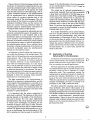
of the excited and ground states are given by P1 − P2 = 1 − 2P2 , and
s/2
P2 =
1 + s + 4δ 2 /Γ2
where s = I/Isat and δ = ν − ν 0 − ν 0 v/c. Isat is called the saturation intensity (for obvious reasons . . . if
you consider the above formula for P2 with δ = 0, P2 “saturates” P2 → 1/2 as I/Isat → ∞). The value of
Page 4