1
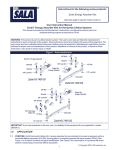
Figure 7 - Connecting to Anchorage
Attaching a Tie-Back Lanyard: See
Figure 8. Place the tie-back lanyard
over the anchoring structure. Ensure
the lanyard is not twisted. Adjust the
floating D-ring so it hangs below the
anchoring structure. Attach the lanyard
end hook to the floating D-ring.
Attaching a Lanyard with Wire Form
Pipe Hook: The wire form pipe hook is
intended for use with pipes up to three
inches in diameter. The anchorage
must be geometrically compatible in
size and shape. See Figure 9 for
examples of proper and improper
connections and intended load
directions. Do not side load the pipe
hook. Do not allow the pipe hook to contact electrical sources. Squeeze the handle to open the hook. Place
hook around the anchorage and release handle. When connecting to an anchorage, ensure the hook fully
closes and closure hooks engage eye loops on hook body.
B. CONNECTING TO THE BODY SUPPORT: Connect the energy absorbing lanyard or energy absorber to the Dring on the back between the shoulders (dorsal D-ring) on a full body harness. Connect so the energy absorber
portion of the lanyard is on the body support side. DBI/SALA does not recommend using a body belt for fall
arrest applications. If using a body belt, connect the energy absorbing lanyard or energy absorber to the D-ring
and position the belt so the D-ring is located on the back side of the body.
Attaching a Lanyard with Web Loops: See Figure 10.
1. Insert the energy absorbing lanyard web loop through the harness web loop or D-ring.
2. Insert the opposite end of the energy absorbing lanyard through the connecting web loop.
3. Pull the attached energy absorbing lanyard through the connecting web loop to secure.
Figure 8 - Attaching Tie-Back
Figure 9 - Attaching Wire Form
Figure 10 - Attaching Web Loop
C. CONNECTING TO A ROPE GRAB (FALL ARRESTOR): It is recommended the lanyard end (vs. the energy
absorber end) be attached to the rope grab. This recommendation is made to reduce possible interference with
the operation of the rope grab by the energy absorber “pack”. Attaching a component style energy absorber to
a rope grab is not recommended, with the exception of a “direct-coupling” between a rope grab and a harness.
Some rope grabs may be supplied with a permanently attached energy absorbing lanyard. For these cases,
use of an additional energy absorber connected between the rope grab and the body support is not
recommended. In some cases it may be permissible to couple an energy absorber component between the
anchorage (or anchorage connector) and the rope grab lifeline. In all cases, ensure the length of the energy
absorber or energy absorbing lanyard does not exceed the rope grab manufacturer's recommended maximum
connection length (3 feet maximum per ANSI Z359.1).
7