1
Proceedings of the 8th WSEAS Int. Conference on SOFTWARE ENGINEERING, PARALLEL and DISTRIBUTED SYSTEMS
So that the results graphs show a correct result
(displacement, speed, pressure, temperature, angle,
…) and the values associated with each port have
the correct units of measurement, the physical
domain to which the different elements of a model
simulation belong can be selected.
Once the composition of a BG model has been
completed, as to both the form and the values
associated with the different elements, everything is
now ready for proceeding to the simulation. To do
this, initially almost all the options are disabled,
since the functions associated with each option
require a certain order. Due to this, as one function
or another is completed, new menu options will be
automatically activated.
5 Obtaining causality
In order to carry out the simulation of a model,
firstly an analysis of causality must be made to
indirectly determine the dependent and independent
variables, the number of algebraic and differential
equations and detect any possible problems. It is for
this reason that the only option activated at the
beginning is this one.
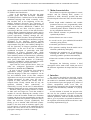
Figure 1: Schematic capabilities of Bondin ©.
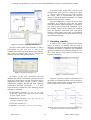
In respect of the name of the elements, as will be
seen further on, this will serve to refer to the
variables associated with the different ports when the
user needs to program and also to interpret the
different equations and graphs produced.
Figure 2: Parameters dialogue box.
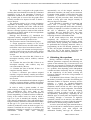
Figure 3: ´Calculation´ menu.
In respect of the value associated with each
element, this may be a numerical, symbolic or mixed
expression. In the latter case the expression may be
dependent on the generic variable ‘t’ (time) or on the
independent variables. Besides the basic operators
contained in the whole expression (+, -, *, /), these
expressions may contain any of the following typical
functions or constants:
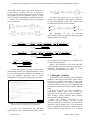
Using the ‘Causality’ option a causal analysis of
the model is performed and the result is shown by
means of the causality lines on the graphs and their
being assigned one colour or another.
• Trigonometric functions: sin, cos, tan, cot, asin,
acos, atan, ascot, sinh, cosh, tanh, coth, arsinh,
arcosh, artanh, arcoth.
• Mathematical functions: sqr, sqrt, exp, lg, ln,
abs, sgn, round, fac, rand.
• Universal constants: pi, e.
• Operators: ! (factorial), ^ (power), % (percentage).
Figure 4: Electrical operation of a lathe by using PI type
regulators with solved causality in Bondin ©.
ISSN: 1790-5117
92
ISBN: 978-960-474-052-9