1
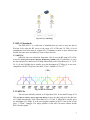
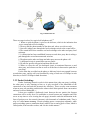
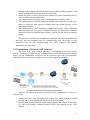
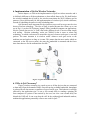
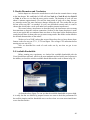
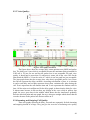
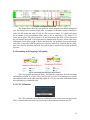
Fig 3.1 PSTN Network
These are steps involved in a typical old telephone call: [14]
1. When we pick the phone, it gives us the dial tone, which is the indication that
we are connected to local exchange.
2. Then we dial the phone number of the other end, where we wish to reach.
3. Our call is taking route through the local exchange switch to the central office.
4. The central office then connects our local exchange to the other end party local
exchange.
5. A connection has been established between us and other party that is taking a
path through the several interconnected switches.
6. The phone on the other end rings and other party answer the phone call.
7. A dedicated circuit is opened between two parties.
8. We talk for specific time period and then end the call.
9. When we close the call, the dedicated circuit is terminated between us and
other party, and releases our line as well as all the lines in between the path that it
was using.
For the time that we talked on the phone, a dedicated circuit was opened between
us and other party, and the call was forwarded by using a fixed rate of 64 Kbps in each
direction; a total of 128 Kbps in both directions.
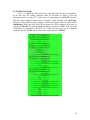
3.2.2 Packet Switching:
Packet Switching Network works in this manner that when one party is talking,
the other party is only listening to him, so it only uses half of the bandwidth of the
connection at any time and this increases the efficiency. There are also some moments
when no party was speaking, and this also reduces these silent periods from conversation
and uses even less bandwidth. [14]
It does not establish a dedicated circuit between the two parties (the Internet
connection will be really slow if it establishes a circuit between our computer and Web
server at any time we were viewing the web page); instead it sends the information in the
form of packets over the network (internet) with thousands of redundant paths. That is
why it is called Packet Switching. Circuit switching opens a connection constantly, while
packet switching opens a connection shortly while it has to send a block of data, which is
called packet, from one side to other, and it works in this manner: [16]
10