1
7.4. LOOPS: WHILE AND FOR
53
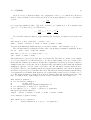
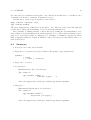
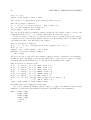
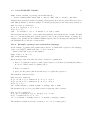
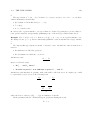
e1 ; e2
If e1 and e2 perform side-effects, this construct ensures that they will be performed in the specified
order (from left to right). In order to emphasize sequential side-effects, instead of using parentheses
around sequences, one can use begin and end, as in:
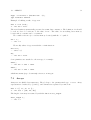
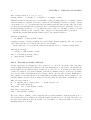
#let x = ref 1 in
# begin
#
x := !x + 1;
#
x := !x * !x
# end;;
- : unit = ()
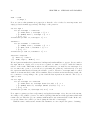
The keywords begin and end are equivalent to opening and closing parentheses. The program
above could be written as:
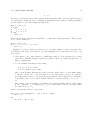
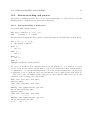
#let x = ref 1 in
# (x := !x + 1; x := !x * !x);;
- : unit = ()
Explicit loops are not strictly necessary per se: a recursive function could perform the same
work. However, the usage of an explicit loop locally emphasizes a more imperative style. Two loops
are provided:
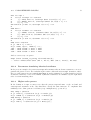
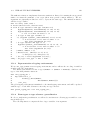
• while: while e1 do e2 done evaluates e1 which must return a boolean expression, if e1 return
true, then e2 (which is usually a sequence) is evaluated, then e1 is evaluated again and so on
until e1 returns false.
• for: two variants, increasing and decreasing
– for v=e1 to e2 do e3 done
– for v=e1 downto e2 do e3 done
where v is an identifier. Expressions e1 and e2 are the bounds of the loop: they must evaluate
to integers. In the case of the increasing loop, the expressions e1 and e2 are evaluated
producing values n1 and n2 : if n1 is strictly greater than n2 , then nothing is done. Otherwise,
e3 is evaluated (n2 − n1 ) + 1 times, with the variable v bound successively to n1 , n1 + 1, . . . ,
n2 .
The behavior of the decreasing loop is similar: if n1 is strictly smaller than n2 , then nothing
is done. Otherwise, e3 is evaluated (n1 − n2 ) + 1 times with v bound to successive values
decreasing from n1 to n2 .
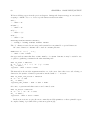
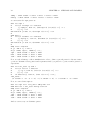
Both loops return the value () of type unit.
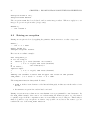
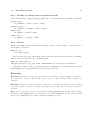
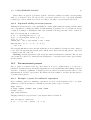
#for i=0 to (vect_length a) - 1 do a.(i) <- i done;;
- : unit = ()
#a;;
- : int vect = [|0; 1; 2|]