1
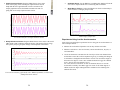
• Mount the WDSS on a free-turning wheel, such as a bicycle wheel. Give it a spin
and allow it to slow gradually. Below are graphs made this way with the wheel
mounted with its axis vertical and horizontal.
Centripetal acceleration (wheel horizontal)
Centripetal acceleration (wheel vertical)
Other experiments require more than one accelerometer to allow you to measure the
net acceleration. The easiest way to set this up is to open the file Experiment
Files/Probes and Sensors/WDSS/Scalar Acceleration. The alternative is to choose
New Calculated Column from the Data Menu to set up a new column that is the
square root of the sum of the squares of the accelerometer readings.
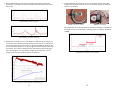
WDSS freefall experiment
• Pendulum experiments: Below is a sample graph made using the WDSS mounted
on a pendulum. The pendulum is swinging through a wide angle, so the angle of
the accelerometer is changing significantly. A simple, one-dimensional
accelerometer would not have done this job as well. In this case, only the net
acceleration is graphed. (See the April 1995 issue of The Physics Teacher for a
discussion of the acceleration of a pendulum.)
• Free fall experiments: Place some packing material (packing peanut, foam, etc.)
in a large box. Simply start data collection and drop the WDSS into the box. All
three accelerometer readings and the net acceleration drop to near zero during the
fall.
Acceleration of the WDSS used as a pendulum bob
33
34