1
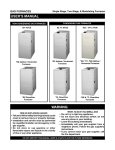
Gas Furnaces
USER MANUAL
Congratulations on the purchase on your new
furnace. With our dedication to quality, superior
reliability, and outstanding warranty, we know you
will be pleased with this new appliance. This furnace
has been designed and built to provide many years
of safe and dependable home comfort, providing it is
properly installed and regular maintenance has been
performed. Improper use or insufficient maintenance
can shorten the life of the furnace and result in serious
personal injury or property damage. Please read this
manual thoroughly and familiarize yourself with the
safety, operation and maintenance procedures for this
furnace.
Safety markings are used frequently throughout this
manual to designate a degree or level of seriousness
and should not be ignored. WARNING indicates a
potentially hazardous situation that if not avoided,
could result in personal injury or death. CAUTION
indicates a potentially hazardous situation that if not
avoided, may result in minor or moderate injury or
property damage.
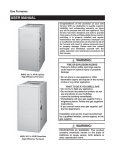
G7XA Upflow/Horizontal
High Efficiency Furnaces
WARNING:
FIRE OR EXPLOSION HAZARD
• Failure to follow safety warnings exactly
could result in serious injury or property
damage.
• Do not store or use gasoline or other
flammable vapors and liquids in the vicinity
of this or any other appliance.
WHAT TO DO IF YOU SMELL GAS
• Do not try to light any appliance.
• Do not touch any electrical switch; do not
use any phone in your building.
• Leave the building immediately.
• Immediately call your gas supplier from a
neighbors phone. Follow the gas suppliers
instructions.
• If you cannot reach your gas supplier, call
the fire department.
G7XC Upflow/Horizontal
Condensing Furnaces
Installation and service must be performed
by a qualified installer, service agency or the
gas supplier.
Table of Contents
Safety Information .....................................................................................................................3
Air for Proper Combustion....................................................................................................3
Flammable Vapors ...............................................................................................................3
Venting System ....................................................................................................................3
Gas Supply and Piping ........................................................................................................3
Combustibles .......................................................................................................................3
Flood Damage .....................................................................................................................4
Shutting Down the Furnace .................................................................................................4
Inspection.............................................................................................................................4
Filters ...................................................................................................................................4
Description of Furnace .............................................................................................................4
Furnaces Components.........................................................................................................4
Venting System ....................................................................................................................4
Combustion Air Requirements .................................................................................................5
Sources of Corrosion ...........................................................................................................5
Furnace in Small Room or Closet ........................................................................................5
Startup and Shutdown ..............................................................................................................5
Starting the Furnace ............................................................................................................5
Shutting Down the Furnace .................................................................................................5
Inspection...................................................................................................................................6
Frequency ............................................................................................................................6
Venting System ....................................................................................................................6
Blower and Filter .................................................................................................................6
Air for Combustion ...............................................................................................................6
Air for Comfort ......................................................................................................................6
Burner Operation ................................................................................................................6
New Construction ................................................................................................................6
Troubleshooting.........................................................................................................................6
Location of Furnace Components ...........................................................................................8
2
SAFETY INFORMATION
WARNING:
The safety information listed throughout this
manual must be followed during the installation,
service, and operation of this furnace. Failure
to follow safety recommendations could result
in possible damage to the equipment, serious
personal injury, or death.
Gas Supply and Piping
This furnace does not have a pilot. It is equipped with an
ignition device which automatically lights the burner. DO
NOT try to light the burner by hand.
BEFORE OPERATING smell all around the furnace area
for gas. Be sure to smell next to the floor because some
gas is heavier than air and will settle to the floor.
WARNING:
Air for Proper Combustion
WARNING:
Do not reduce the supply of fresh air to the
furnace. This could create the production of
excessive amounts of Carbon Monoxide - a
colorless, odorless gas that is a deadly poison
that could result in serious personal injury
or death. Do not block any openings that are
supplying fresh air to the room or closet the
furnace is in. If your furnace obtains its air
through a pipe to the outdoors, do not allow
the inlet of the pipe to become blocked.
Flammable Vapors
WARNING:
Do not place combustible materials on or against
the furnace cabinet or within 6 inches of the
vent pipe. Do not place combustible materials,
including gasoline or any other flammable
vapors and liquids, in the vicinity of the furnace.
A fire or explosion may result causing property
damage, personal injury or loss of life. Failure to
follow the safety warnings exactly could result
in serious injury, death or property damage.
Venting System
WARNING:
It is imperative to maintain proper operation of
the venting system. Insufficient venting could
create the production of excessive amounts
of Carbon Monoxide - a colorless, odorless
gas that is a deadly poison that could result in
serious personal injury or death.
All gas piping and shutoff valves must be
installed in compliance with local codes and
utility regulations by licensed installers. DO
NOT attempt to modify, or tap into existing
gas lines yourself. Fire or explosion may result
causing property damage, personal injury or
loss of life. Failure to follow the safety warnings
exactly could result in serious injury, death or
property damage.
WARNING:
The furnace was shipped from the factory
equipped to operate on natural gas. Conversion
to LP/propane gas must be performed by a
licensed HVAC technician using a factory
supplied conversion kit. Failure to use the
proper conversion kit can cause fire, explosion,
property damage, carbon monoxide poisoning,
personal injury, or death.
Combustibles
WARNING:
Do not place combustible material on or
against the furnace cabinet or within 6 inches
of the vent pipe. Do not place combustible
materials, including gasoline and any other
flammable vapors and liquids, in the vicinity
of the furnace.
The furnace is designed to have certain clearances to
combustible items such as wood, paper, etc. Some types
of insulation are combustible. If your furnace is installed
in an attic, near unfinished walls, or in other insulated
space, keep area surrounding the furnace free of insulating
material. Do not put insulation on your furnace.
3
SAFETY INFORMATION
Flood damage
WARNING:
Do not use this furnace if any part has been under
water. A flood damaged furnace is extremely
dangerous. Attempts to use the furnace can
result in fire or explosion. A qualified service
agency should be contacted to inspect the
furnace and to replace all gas controls, control
system parts, electrical parts that have been
wet or the furnace if deemed necessary.
Shutting Down the Furnace
Should you ever need to shut down your furnace for
service or maintenance, shut off the gas at the gas valve
first by moving the switch to the OFF Position (Figure 1).
If your installation has a manual gas shutoff valve on the
gas supply pipe, shut this off, then shut off the electric
to the furnace.
Inspection
Your furnace and its venting system should be inspected
annually by a licensed HVAC technician. The filter should
be inspected at least once a month. See the section about
inspections (Page 8) that you can do yourself.
Filters
WARNING:
Never operate the furnace without a filter in
place. Accumulating dust in the return air can
build up on internal components, resulting
in loss of efficiency, equipment damage, and
possible fire.
• Air filter(s) are not supplied with the furnace as
shipped from the factory. The installer must provide
a high velocity filter and rack for a filter in the return
air duct adjacent to the furnace, or in a return air grill
to the furnace.
• The furnace should always have a clean filter located
either at the air return on the furnace or in an air
return register in your habitable space. If the filter
becomes dirty, it should be cleaned or replaced.
• New or newly renovated homes may require more
frequent changing until the construction dust has
minimized. Filters designed to remove smaller
particles such as pollen, may require additional
maintenance.
Figure 1. Gas Valve
DESCRIPTION OF FURNACE
Furnace Components
The furnace components on page 8 will help you locate
the different parts of the furnace. The control you need
to familiarize yourself with is the gas valve. You will use
this to turn the furnace on and off. There are no user
serviceable parts. All repairs should be done by a licensed
HVAC technician.
4
Venting System
This furnace is designed to fulfill the requirements of
being classified as either Category I or a Category IV
furnace.
COMBUSTION AIR REQUIREMENTS
CAUTION:
Do not reduce the supply of fresh air to the
furnace. It is extremely important that the
furnace receives an unobstructed flow of clean,
fresh air to properly burn the fuel gas. If this
flow of air is restricted, the partially burned
combustion gases may create dangerous
amounts of carbon monoxide - a colorless,
odorless gas that is a deadly poison that can
cause personal injury or death.
Air openings on top of the furnace and openings in closet
doors or walls must never be restricted. If the furnace is
operated without adequate air for combustion, the flame
roll-out switch will open, turning off the gas supply to the
burners. This indicates that a serious problem with the
burners has occurred and must be corrected immediately.
Only a licensed HVAC technician can reset this switch.
Sources of Corrosion
It is known that certain common household chemicals
can cause heat exchanger corrosion if they are pulled
into the furnace’s burners
The following is a list of chemicals that should not be used
or stored near the furnace.
Do not store these chemicals near the furnace:
• Permanent wave solutions
• Chlorinated waxes and cleaners
• Chlorine based swimming pool chemicals
• Water softening chemicals
• De-icing salts or chemicals
• Carbon tetrachloride
• Halogen type refrigerants
• Cleaning solvents (perchloroethylene)
• Printing inks, paint removers, varnishes, etc.
• Hydrochloric acid
• Cements and glues
• Antistatic fabric softeners
• Masonry acid washing materials
Furnace in Small Room or Closet
If a furnace is installed in relatively small utility room or
closet, the installation needs openings in the walls or door
to let combustion air in. Make sure that these openings
remain unobstructed. Do not modify these openings in any
way without consulting a licensed HVAC technician.
STARTUP AND SHUTDOWN
Starting the Furnace:
1. Make sure the filter is clean and in place.
2. Make sure the vent system is properly installed.
3. Set the thermostat to the lowest setting.
4. Close the manual gas valve outside the furnace.
5. Turn off all electric to the furnace.
6. Remove the door from the burner compartment.
7. Move the switch on the gas valve to the OFF position.
See Figure 2 for valve switch location.
8. Wait 5 minutes. If there is any smell of gas, see WHAT
TO DO IF YOU SMELL GAS on page 4.
9. Move the switch on the gas valve to the ON
position.
10. Turn on all electric to the furnace.
11. Open the manual gas valve.
12. Turn thermostat back up to force ignition.
13. Observe operation, including burners. If burners fail
to ignite, call a licensed HVAC technician.
14. Replace the door on the burner compartment.
Shutting Down the Furnace:
Should you ever need to shut down your furnace for service
or maintenance, follow these steps:
1. Set the thermostat to the lowest setting.
2. Close the manual gas valve outside the furnace.
3. Turn electric to the furnace off.
4. Open the door to the burner compartment.
5. Move the switch on the gas valve to the OFF position.
See Figure 1 on page 4 for valve switch location.
6. Replace the door on the burner Compartment.
5
INSPECTION
Frequency
The furnace should be inspected annually by a licensed
HVAC technician. Homeowners should perform frequent
visual inspections.Table 1 contains suggested inspections
and frequency of maintenance.
Venting System
• Existing vent pipes should be inspected and any corroded
sections must be replaced. Obstructions or blockage
must be removed by a licensed HVAC technician.
• Flue passageways, the vent system, and the burners
should be inspected and cleaned (if required) by a
licensed HVAC technician annually to ensure continued
safe operation.
Blower and Filter
is recommended that the blower compartment be
cleaned of dirt or lint that may have accumulated in the
compartment or on the blower and motor as part of the
annual inspection.
It
Air for Combustion
• For proper and safe operation, the furnace needs air for
combustion and ventilation. Do Not block or obstruct
air openings on the furnace, or any air openings where
the furnace may be installed, including any surrounding
spaces.
• Direct vent furnaces pull combustion air from the
outdoors and vent combustion products back outside.
Combustion air coming from the outside needs to be
clean of chemicals that can cause corrosion, such as
pool chlorinating products.
Air for Comfort
• Keep air filters cleaned. It is recommended that the
furnace air filter be checked at least once a month. Clean
or replace filter to maintain proper airflow and achieve
maximum efficiency.
• Furniture and drapery should be arranged so that
the supply air registers and return grilles are not
obstructed.
Burner Operation
Perform the startup instructions on page 7. The igniter
should ignite the closest burner and the flames should
quickly carryover to the other burners. The flames should
be bright blue, with occasional yellow streaks.
FREQUENCY OF MAINTENANCE
BEGINNING OF
EACH HEATING
SEASON
END OF EACH
HEATING SEASON
MONTHLY
Verify furnace area is free of combustible materials.
X
X
X
Verify combustion and ventilation air is not restricted.
X
X
X
Verify no signs of physical deterioration of the furnace.
X
X
X
Verify no obstructions or restrictions in vent or chimney.
X
X
Verify no holes or cracks in vent pipe.
X
X
Verify no corrosion in vent pipe.
X
X
Verify the horizontal vent pipes slope upwards away from furnace.
X
X
Verify burner flame.
X
MAINTENANCE ITEM
X
Clean or replace filter(s).
Clean blower compartment.
X
Clean burner assembly.
X
Clean condensate collection and disposal system (if applicable).
X
Table 1. Maintenance Table
TROUBLESHOOTING
If the furnace fails to operate check the following:
1. Is the thermostat operating properly?
2. Are the blower compartment door(s) in place?
3. Has the circuit breaker tripped or the control board
fuse burned open?
6
4. Is the gas turned on at the manual shutoff?
5. Is the filter dirty or clogged?
If the furnace continues to not operate, contact a licensed
HVAC technician
7
LOCATION OF FURNACE COMPONENTS
9
FLAME
BLOWER
OFF
DELAY
14
3
8
6
STATUS
HEAT
COOL
FAN
24V
R C Y G W
9 6 3
8 5 2
7 4 1
10
5
4
180
120
90
60
7
13
10
14
5
10
13
8
6
9
15
2
3
2
11
1
LOW
ML
MH
HIGH
EAC
L1
XFMR
HUM
NEUTRALS
L1A
7
6 3
5 2
4 1
15
4
1
11
12
12
G7XC Upflow/Horizontal Condensing Gas Furnace
G7XA Upflow/Horizontal Gas Furnace
1. Blower Assembly
6. Gas Manifold
11. Motor Choke
2. Blower Door Switch
7. Gas Valve
12. Motor Control Board
3. Burner Assembly
8. Igniter
13. Pressure Switch
4. Furnace Control Board
9. Inducer Assembly
14. Roll-Out Switch
5. Flame Sensor
15. Transformer
10. Limit Switch
¢708930'¤
7089300
7089300
O’Fallon, MO
Specifications and illustrations subject to change without notice
and without incurring obligations. Printed in U.S.A
8