1
On Board Wireless Secured Video Surveillance: BOSS project
BOSS sequences documentation
structure of the train (this would have required drilling holes in the frame of the train, which was not allowed by
RENFE), and moreover it happened that actors banged into a camera, which imposed recalibrating the cameras.
This is why calibration parameter sets are provided with each sequence: one must use the set that comes with the
sequence, as using another parameter set may yield poor reconstruction.
The following is aimed to explain how to use calibration data sets; pixel map tables from original to undistorted
images, and intrinsic and extrinsic calibration parameters. These data sets are computed through the process
explained in the “calibTutorial.pdf” file, provided with the data set.
Note: the OpenCV library9 is required to compile every sample C++ code under src/ directory. The sample
source code is available in the BossCalibDescription/src subdirectory of the Boss data set.
5.1
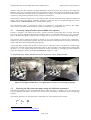
Correcting image distortion from a BOSS video sequence
Cameras 2 through 9 use fisheye lenses with a specific projection (f-theta) that does not allow direct 3D
processing using the algorithms designed for rectilinear lenses. It is therefore necessary, as a first processing
step, to “undistort” the fisheye images to obtain an image that can be processed by conventional 3D algorithms.
The necessary data to undistort the images of camera N of a given sequence are stored in the “calib/CamN”
subdirectory of the corresponding sequence. Note that this data does not change between sequences, because the
cameras and lenses did not change during the shooting.
A pixel map table is stored in files Xcoord.csv and Ycoord.csv, which give x and y coordinates on original image,
respectively. Each file contains tab-separated float values in the same order as the mapped image, meaning that
the pixel (x,y) in the original frame will be mapped to location (Xcoord[x,y], Ycoord[x,y]) in the undistorted
frame. This mapping is done by running the projectimg.cc sample C++ code :
% ./projectimg input_image_filename Xcoord.csv Ycoord.csv output_image_filename
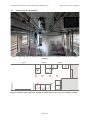
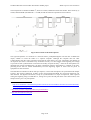
Figure 23: Example of undistortion: (a) original frame (b) frame corrected using projectimg
5.2
Projecting the 3D points onto images using the calibration parameters
The undistorted frames can be processed for 3D like any frame shot using an “ordinary” lens. The intrinsic and
extrinsic calibration parameters of camera N are stored in the “calib/CamN” subdirectory of the corresponding
sequence.
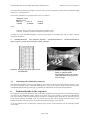
The intrinsic parameters are specified in file “intrinsicPars.ini, in the following matrix format:
170
0
0
9
0
170
0
360
288
1
http://sourceforge.net/projects/opencvlibrary/
Page 15/21