1
METTLER TOLEDO Jaguar/Jagxtreme PLC and Analog Interface Technical Manual
Floating Point Data Format and Compatibility
In Floating Point Message mode, the PLC and terminal exchange weight, rate, setpoint,
and tare data in single-precision floating point format. The IEEE Standard for Binary
Floating-Point Arithmetic, ANSI/IEEE Standard 754-1985, specifies the format for singleprecision floating point numbers. It is a 32-bit number that has a 1-bit sign, an 8-bit
signed exponent, and a 23-bit mantissa. The 8-bit signed exponent provides scaling of
weight and rate data. The 23-bit mantissa allows representation of 8 million unique
counts.
Although the single-precision floating point number provides greater numerical precision
and flexibility than integer weight representations, it has limitations. The weight
representation may not be exact, particularly for the extended-resolution weight fields for
high-precision bases.
Some Allen-Bradley PLCs require special integrity checking to communicate floating
point numbers across the Remote I/O link. The Allen-Bradley PLC-5 and KTX Scanner
Card programs must check two data integrity bits to verify the integrity of the floating
point data it reads from the terminal. Allen-Bradley SLC programs always read valid
floating-point data from JAGXTREME terminals and do not have to make special checks
to guarantee the validity of the floating-point data. The Allen-Bradley PLC-3 and PLC5/250 cannot support terminals in floating point mode as they cannot guarantee the
integrity of the floating-point data.
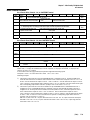
There are two data integrity bits that the terminal uses to maintain data integrity when
communicating with the Allen-Bradley PLC-5 Remote I/O Scanner or KTX Scanner Card.
One bit is in the beginning byte of the data; the second is in the ending byte of the data
for a scale slot. The PLC program must verify that both data integrity bits have the same
polarity for the data in the scale slot to be valid. There is a possibility that the PLC
program will see several consecutive invalid reads when the terminal is freely sending
weigh updates to the PLC-5 program detects this condition, it should send a new
command to the terminal.
The Allen-Bradley SLC PLC programs do not have to make special checks to guarantee
the validity of the floating-point data.
Shared Data Mode
The Shared Data mode PLC communications is not available in Allen-Bradley PLCs.
Block Transfer communications is used instead.
Block Transfer
Note: Do not use Block Transfer mode
for real-time communications.
Block Transfer mode is much less efficient than the discrete data modes, which are
optimized for real time communications of weight and status data. Block Transfer mode
accesses the terminal’s “Shared Data” directory structure each time a data item is
accessed. By contrast, the weight-synchronous mode communications has a direct
interface to a limited number of real time terminal data fields.
Block Transfer Data
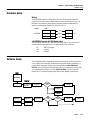
Block transfer allows the JAGXTREME terminal and PLC to exchange many types of data
in blocks of up to 128 bytes. It also enables the PLC to write messages directly to the
terminal's lower display area.
Block transfer works concurrently with discrete data. Discrete mode communicates
continuously in the background and a block transfer occurs only when the PLC program
executes a block transfer read or write instruction. Data transfer is controlled by the PLC.
1-18
(1/03)