1
Appendix C: Single-Source Graph Searches
While the Floyd-Warshall Algorithm is useful for all pairs shortest-paths searches, for graphs of
even medium size (say, a few thousand nodes), its cubic runtime becomes impractical. When we
are interested in a more limited result – say, the shortest distance/shortest path between just two
nodes, then it is possible to be much more efficient. For example, you need not touch all the
nodes/edges of the graph – when the “destination” is found, the search can stop.
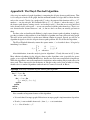
For the case of unweighted graphs (as in IMDB), this leads to two particularly simple graph
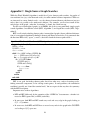
search algorithms: breadth-first search (BFS; Algorithm 2) and depth-first search (DFS; Algorithm 3).
BFS is well-suited to finding shortest paths: in unweighted graphs (absent additional information) it is an optimal algorithm for finding a shortest path between two nodes. It is guaranteed that
the first time BFS visits (“opens”) a node n, that it has found the shortest path to that n.
Algorithm 2 The Breadth-First Search (BFS) Algorithm
Input: Graph G = hV, Ei; start node from ∈ V ; end node to ∈ V
OPEN ← from
CLOSED ← from
done ← false
while !done AND !isEmpty(OPEN) do
here ← OPEN.removeFromFront()
for n ∈ G.neighborSet(here) do
if n ∈
/ CLOSED then
CLOSED.add(n)
OPEN.addToEnd(n)
if n == to then
done ← true
end if
end if
end for
end while
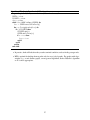
DFS is not good for finding shortest paths, but it has other uses, such as detecting cycles,
finding connected components, or for solving certain games. In such problems, the termination
condition is usually not “found the terminal node,” but we express it that way here for symmetry
with the BFS description.
Important notes on these algorithms:
• DFS and BFS differ only by the semantics of the “OPEN list” data structure – whether it is
treated as FIFO (queue-like) or LIFO (stack-like).
• In worst case, both BFS and DFS touch every node and every edge in the graph, leading to
O(V + E) runtime.
• In worst case, both BFS and DFS have to record every node in the graph in the CLOSED
set, leading to O(V ) space use.
26