1
16
Luciano Nicastro and Giorgio Calderone
6.1 Optical and IR catalogues sky maps
For our tests on real data we used catalogues which are routinely used for
real-time objects identification in images taken by the IR/optical robotic
telescope REM (Molinari et al. [6]). Among them: GSC 2.3, GSC 2.2 (∼
18th mag threshold), USNO B1.0, 2MASS, UCAC 2.0, ASCC 2.5 (see the
web sites: www-gsss.stsci.edu/, www.nofs.navy.mil/, www.ipac.caltech.edu/,
ad.usno.navy.mil/, cdsarc.u-strasbg.fr/). Using DIF we have indexed these
catalogues with various pixelizations. The performed tests confirm the results
obtained for the fake tables, i.e. the fastest access time is achieved by using
pixels of size ∼ 1◦ . We recall that the GSC 2.3 is distributed as 32768 FITS
files, each covering a d = 6 HTM trixel, whereas USNO B1.0 and 2MASS are
split in files covering 0 ◦. 1 in Dec, RA ordered in the slice. To further speed-up
the region look-up, which for REM is 100 ×100 , we added coordinates indexing.
For optimization and disk space saving reasons, coordinates were converted
into cent-arcsec and therefore packed into 4-bytes integers. Then a “unique”
combined index was created on HTM ID plus coordinates. As already noticed
in [1], with such an index and the usage of coordinate ranges in the WHERE
clause to further reduce the number of rows to seek/access, queries on regions
of size 100 –300 take ∼ 20 ms.
Using IDL routines to visualize as sky maps data read from MySQL tables
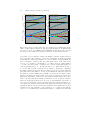
is quite straightforward. As said, the HEALPix pixelization schema and routines can be used to this aim. For example in Fig. 4 we show the UCAC 2.0 sky
objects density in galactic orthographic projection. The map was build using
k = 8, i.e. a pixel size of ' 140 . The sky region not covered by the catalogue is
shown in grey. In the same figure the average B − V of the ASCC 2.5 objects
in pixels of area 13.4 deg2 is shown in galactic mollview projection. A simple
(and basic) IDL program to produce the first map is:
@mcs_healplib
; Include MCS-Base and MCS-HEALPix Functions/Programs
COMMON HEALPmap, hp_nested, hp_nside, hp_order, hp_npix, $
hp_emptypix, hp_npixok, hp_map_nocc, hp_map_sum
hp_order = 8
Query = ’select healpID_0_8 from UCAC_2orig’
DBExec_Qry(’MyDB_name’, ’User_name’, ’Password’, Query)
healp_MapFill()
orthview, hp_map_nocc, rot=[45,45], coord=[’C’,’G’], /grat, col=5
Note: 1. mcs_healplib(.pro) has all the high level routines needed to build
and save HEALPix maps; it also loads mcs_usrlib which is used to access
MySQL tables. 2. The common block HEALPmap is used to pass the map parameters among the various routines. 3. If the UCAC_2orig table does not have
the healpID_0_8 column (e.g. it is not indexed) then simply change the query
into: ’select HEALPLookup(0,8, RAcs/3.6e5,DECcs/3.6e5) from UCAC_2orig’
which will calculate the IDs for k = 8 on the fly. 4. healp_MapSave() can
be used to write the map into a FITS file. On the MCS web site some demo
programs are available to help writing custom programs and routines.