1
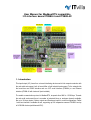
The power options include either 5V or any voltage from 7 to 35V DC. The consumption mainly
depends on the load on the binary outputs (these can be supplied from a separate DC source,
usually 12 or 24V). The outputs can directly drive resistive or inductive loads up to 3W with
maximum current of 200 mA per output channel.
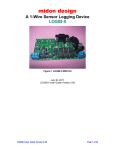
The device has an on-board PIC-microcontroller, taking care all of the communication, multiplexing
and calculations needed to sync the I/O channels with the content of the available Modbus
registers. Some useful properties of the board to mention are the built-in 32-bit counters for each
binary input and the ability to generate pulses with exactly controlled length from 1ms to 4s on the
binary outputs. The board is able to supply 5V power to other devices, with or without watchdog
reset functionality. The watchdog is able to cut the 5V power to the external device for a predefined
time in case of no Modbus communication detected for another predefined time.
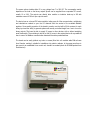
The board can be easily (without any tools or screws) fitted into a 6 modules wide DIN-rail case
from Camden, making it suitable for installations into electric cabinets. In the same case there is
also room for an embedded Linux control unit, should it be needed (check for DC6888 product from
Droid4control).