1
Spelling
.
.
.
.
.
.
.
.
.
.
.
Punctuation
.
.
.
.
.
.
.
.
.
.
.
.
.
.
.
.
.
.
.
.
.
.
.
Case
.
.
.
.
.
.
.
.
.
.
.
.
.
.
.
Syntax
.
.
.
.
.
.
.
Expected texts
(e.g. AP newswire)
1% errors
standard
upper and lower
case conventions
TDD texts
5% errors
little or
none
single case only
.
.
.
.
.
.
.
.
.
.
.
st. English
dialect
written
language of
the deaf
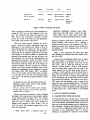
Figure I: TDD vs. Expected Text Input
makes it possible to automate part of this arrangement by
reading the TDD text over the telephone to the voice
user. The synthesizer thus replaces an operator on the
TDD half of the conversation, providing increased
privacy and control to the TDD user and, presumably,
cost savings to the provider of the service.
TDD texts present unusual challenges for text-tospeech. Except in laboratory experiments, large scale
applications of text-to-speech have tended to focus on
name pronunciation and "canned text" such as catalogue
orders. To the best of our knowledge, the TRS text-tospeech field trial in California represents the first large
scale attempt to use speech synthesis on spontaneously
generated conversational texts, and also the first to use
this technology on texts that are orthographically and
linguistically non-standard. Unlike the written material
that most text-to-speech systems are tested on, e.g. the
AP newswire, TDD texts observe few of the writing conventions of English. All text is in upper case, and punctuation, even at major sentence boundaries, rarely occurs;
spelling and typographical errors complicate the picture
even further (Tsao 1990; Kukich, 1992). In addition,
nearly all texts employ special abbreviations and lingo,
e.g., CU stands for see you, GA is the message terminator go ahead. The following example illustrates a typical
TDD text:
OH SURE PLS CAIJ. ME ANYTI/V[E AFTER SAT
MORNING AND I WILL GIVE U THE NAMES
AND PHONE NOS OK QGA
(Oh sure, please call me anytime after Saturday
morning and I will give you the names and phone
numbers. OK? Go ahead.)
Finally, many texts are written in a variety of English
that departs from expected lexical and syntactic patterns
of the standard dialect (Charrow 1974). For example,
WHEN DO I WIIJ. CAIJ. BACK U Q GA is a short
TDD text that we believe most native speakers of
English would recognize as When should I call you
back? Go ahead. The (attested) example below is less
clear, but interpretable:
I
WISH
THAT
DAY
I
COULD
LIKE
TO
26
MEETING DIFFERENT PEOPLE WHO DOES
THIS JOB AND THE WAY I WANT TO SEE
HOW THEY DO IT LIKE THAT BUT THIS
PLACES WAS FROM SAN FRANCISCO I GUESS
Syntactic variation in such texts is systematic and consistent (Bacbenko 1989, Charrow 1974). Although a
complete account has yet to be formulated, Suri (1991)
reports that aspects of the variation may be explained by
the influence of a native language--ASL--on a second
language--English.
Figure 1 above summarizes the points about TDD
texts. Spelling error estimates come from Kukich (1992)
and Tsao (1990).
Timing creates an additional obstacle since we expect
TRS text-to-speech to synthesize the text while it is
being typed, much as an operator would read it at the
TRS center. How to chunk the incoming text now
becomes a critical question. Word by word synthesis,
where the listener hears a pause after each word, is the
easiest approach but one that many people find nervewracking. N-word synthesis, where the listener hears a
pause after some arbitrary number of words, is nearly as
simple but runs the risk of creating unacceptably high
levels of ambiguity and, for long texts, may be as irritating as single-word synthesis. Our solution was to build a
TDD parser that uses linguistic roles to break up the
speech into short, natural-sounding phrases. With partial
buffering of incoming text, the parser is able to work in
near real time as well as to perform lexical regularization
of abbreviations and a small number of non-standard
forms.
3. A TEXT-TO-SPEECH PARSER
3.1. PARSER STRUCTURE AND RULES
In constructing the parser, our goal was to come up with
a system that (a) substitutes non-standard and abbreviated
items with standard, pronounceable words, and (b) produces the most plausible phrasing with the simplest possible mechanism. Extensive data collection has been the
key to success in regularizing lexical material, e.g. the
conversion of fwy (pronounced "f-wee") to freeway.
Phrasing is accomplished by a collection of rules derived