1
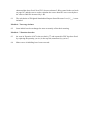
Note that the first equation on the previous page applies only to wooden studs. For
steel studs, the numerator should be divided by 10.
The above modifications were made as a result of extensive discussions with the
originator of the Davy theory, Dr John Davy, and give a better match between theory
and experiment.
101.
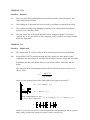
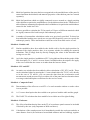
The Sharp model for double wall transmission loss has been modified slightly in that
point B in Figure 8.9 in the text is 0.5 fc1 instead of 0.5 fc2 and the equations in the
figure caption have been changed to:
(a)
Line–line support:
1/2
TLB2 ' 20 log10 m1 % 10 log10 b % 20 log10 fc1 % 10 log10 fc2 % 20 log10 1 %
(b)
& 78 (dB)
1/2
m1 fc2
Line–point support ( fc2 is the critical frequency of the point supported panel):
TLB2 ' 20 log10 m1 e % 20 log10 fc1 % 20 log10 fc2 & 99
(c)
m2 fc1
(dB)
Point–point support:
TLB2 ' 20 log10 m1 e % 20 log10 fc1 % 20 log10 ( fc2 ) % 20 log10 1 %
m2 fc1
m1 fc2
& 105
(dB)
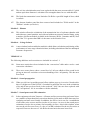
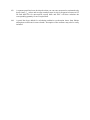
Point C:
fc2
(a)
fc2 … fc1 ,
TLC ' TLB % 6 % 10 log10 η2 % 20 log10
(b)
fc2 ' fc1 ,
TLC ' TLB % 6 % 10 log10 η2 % 5 log10 η1
fc1
(dB)
(dB)
The above adjustments result in better agreement between experimental data and predictions
for double walls.
VERSION 3.2
The following additions and corrections are included in version 3.2.
102.
Two new windows have been added to Module 5 called "Duct Modal" and "Plenum"
(see below)
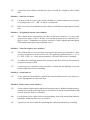
Module 5 – Duct modal
103.
This module allows you to calculate modal cut-on frequencies, number of cut-on
modes for a specified frequency and the phase speed of a specified mode at a
specified frequency for rectangular and circular ducts.
104.
This module also allows the calculation of the attenuation of sound propagating in
unlined ducts, with or without external lagging.
Module 5 – Dissipative Mufflers