1
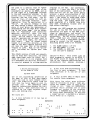
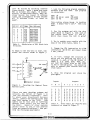
and lead to a special type of "geom etry". A cell at either edge is not considered as special by NBRS, and so to the right of a right-edge location is the next sequential address. On the screen this is really the left edge location, and one line lower. The in verse is true, of course for left ad dresses of left-edge locations. Topo logically, this is equivalent to a "helix". No special effects of this are seen during a simple LIFE evolution since it just gives the impression of disappearing off one edge while appear ing on the other edge. For an object like the "spaceship" (see Scientific American articles), then, the path eventually would cover the whole LIFE arena. The fun comes in when a config uration spreads out so much that it spills over both edges, and interacts with itself. This, of course cannot happen in an infinite universe, so that some of the more complex patterns will not have the same fate in the present version of LIFE. Most of the "blink ers", including the "glider gun" come out OK. language on the PET. One confession, however - I used the KIM-1 to debug most of the subroutines. Almost all of them did not run on the first shot! Without a good understanding of PET memory allocation particularly in page zero, I was bound to crash many times over, with no recovery other than pul ling the plug. The actual BASIC pro gram consisted of aPOKING loop with many DATA statements (always save on tape before running!). Although the LIFE program was designed for use on the PET (8K version), no references are made to PET ROM loca tions or subroutines, and except for MAIN and SUBROUTINE address, are fully relocatable. The PET screen addresses (8000 - 83E8 hex) are treated as RAM. For anyone (with a 6502-based system) trying to convert the PET program, the following points need to be watched: 1. 2. 3. This H0x25 version of LIFE can undoubt edly be made more efficient, and other edge algorithms could be found, but I chose to leave it in its original form as a benchmark for my first successful ly executed program in writing machine The The The for BLANK symbol = 20 hex DOT symbol = 51 hex OFFSETS in DATA must be set the user's display. [Editor's Note: This seems like an ideal program to convert to an APPLE II and MICRO would be happy to print a list of the required modifications and enhancements that someone develops.] 2. A cell dies from overcrowding if it has four or more neighbors. It dies from isolation if it has one or zero neighbors. A Brief Introduction to the Game of Life by Mike Rowe 3- A cell is born when an empty space has exactly three neighbors. One of the interesting properties of the game of LIFE is that such simple rules can lead to such complex activ ity. The simplicity comes from the fact that the rules apply to each in dividual cell. The complexity comes from the interactions between the indi vidual cells. Each individual cell is affected by its eight adjacent neigh bors, and nothing else. With these few rules, many different types of activity can occur. Some pat terns are STABLE, that is they do not change at all. Some are REPEATERS, patterns which undergo one or more changes and return to the original pattern. A REPEATER may repeat as fast as every other generation, or may have a longer period. A GLIDER is a pattern which moves as it repeats. The rules are: 1. A cell survives if it has two or three neighbors. REPEATERS « « « ft STABLE « ft ft • * • ft * * * ft * ft ft ft ft « ft ft ft GLIDERS ft ft ft ft ft ft « 5:7 IMOQiaQi ft • *« » ft * *«*ftft*