1
Line Array User’s Manual
PLEASE take a little time to learn how to get great results with your
Renkus-Heinz Line Array System. It’s a small investment that will
generate a large payoff: more satisfied clients, more efficient
operations and better recognition for your skill as a sound
reinforcement professional.
INTRODUCTION
Renkus-Heinz Engineering has developed unique approaches to the line array
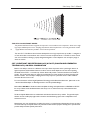
The Isophasic Plane Wave Generator lens shapes high frequency response so that vertical arrays produce a
continuous, coherent wavefront whose curvature can be shaped to the audience area by curving the array.
The Midrange Diffraction Baffle used in the PN102/LA and PNX102/LA modules moves the woofers’ acoustic
centers closer together in the horizontal plane to eliminate “coverage collapse” in the crossover region.
The CDT1.5 CoEntrant Driver used in the STLA/9 and STXLA/9 integrates 6.5 inch carbon fiber cone and 2.5
inch voice coil titanium compression drivers into a high output wideband point source.
Line Arrays are not hard to use when you understand how they work…
The R&D behind our Line Array Systems is grounded in years of practical experience with the problems of
delivering reference reproduction for large audiences at professional SPLs. Our engineered solutions include a
simple yet highly accurate software design tool – AimWare. The flying hardware is keyed to the design software
and will easily enable you to fly your array at the height and angle determined using AimWare, and with the
proper curvature. Self-powered line array modules include all the system optimization and protection functions
needed to ensure peak performance. Externally-powered modules use RH-Engineered controllers to provde
the same high performance with centralized power amplifier racks.
… but curved vertical arrays require different design techniques…
For the past 20 years, sound reinforcement professionals have worked with horizontal arrays that use
megaphone-variant horns to deliver “[more or less] equal power to equal angles.” Vertical arrays (so-called “line
arrays”) are designed to deliver “[more or less] equal power to equal areas.” This is the key to consistent SPL
and frequency response from the front to the rear of the audience area.
... and unfamiliar operational practices.
Over the years, system designers and operators have developed a number of signal processing techniques to
disguise and partly overcome the limitations of “constant directivity” horns: for more information on these
techniques and their limitations, see our White Papers on the True Array Principle and Reference Point Array
design. “Frequency shading,” “amplitude shading,” “system tuning,” all of these are tools of the advanced sound
system operator.
WHILE THESE TECHNIQUES ARE APPLICABLE TO LINE ARRAYS, THEY OFFER LIMITED IMPROVEMENT TO
THE LINE ARRAYS PERFORMANCE. Instead of enhancing the array’s performance they could severely degrade
it.This is because line array performance depends on all array modules receiving the same signal at the same level,
in order to produce a continuous, coherent wavefront. Coverage control is achieved by mainly by tilting and
curving the array relative to it’s hang height. Subtle amplitude shading of the bottom most loudspeakers can
improve front to back coverage consistency, but it needs to be used with care.
For more information on line array design practices, refer to pages 10 to 12 of this manual.
3