1
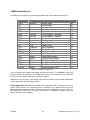
End-of-Interrupt (EOI) Command
After an interrupt service routine is complete, the 8259 Interrupt Controller must be acknowledged
by writing the value 20h to port 20h.
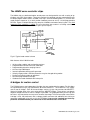
What exactly happens when an interrupt occurs?
Understanding the sequence of events when an interrupt is triggered is necessary to correctly
write interrupt handlers. When an interrupt request line is driven high by a peripheral device (such
as the ESC629), the interrupt controller checks to see if interrupts are enabled for that IRQ. It then
checks to see if other interrupts are active or requested and determines which interrupt has priority. The interrupt controller then interrupts the processor. The current code segment (CS), instruction pointer (IP), and flags are pushed onto the system stack, and a new set if CS and IP are
loaded from the lowest 1024 bytes of memory.
This table is referred to as the interrupt vector table and each entry to this table is called an interrupt vector. Once the new CS and IP are loaded from the interrupt vector table, the processor
starts to execute code from the new Code Segment (CS) and from the new Instruction Pointer
(IP). When the interrupt routine is completed the old CS and IP is popped from the system stack
and the program execution continues from the point where interruption occurred.
Using Interrupts in your Program
Adding interrupt support to your program is not as difficult as it may seem especially when programming under DOS. The following discussion will cover programming under DOS. Note that
even the smallest mistake in your interrupt program may cause the computer to hang up and will
only restart after a reboot. This can be frustrating and time-consuming.
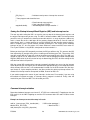
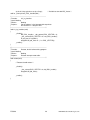
Writing an Interrupt Service Routine (ISR)
The first step in adding interrupts to your software is to write an interrupt service routine (ISR).
This is the routine that will be executed automatically each time an interrupt request occurs for the
specified IRQ. An ISR is different from other sub-routines or procedures. First, on entrance the
processor registers must be pushed onto the stack before anything else! Second, just before exiting the routine, you must clear the interrupt on the ESC629 by issuing the RSTI instruction and
reading the interrupt status register, and finally write the EOC command to the interrupt controller.
When exiting the interrupt routine the processor registers must be popped from the system stack
and you must execute the IRE assembly instruction. This instruction pops the CS, IP and processor flags from the system stack. These were pushed onto the stack when entering the ISR.
ESC629
26
RTD Embedded Technologies, Inc