1
Application 4: Aligning measurements to IRIG-B
This example discusses a more advanced application that uses other features of the DAPL system in
addition to the Time Base and Synchronization package.
For this application, the goal is to record underground geological disturbances over a long period of
time. If something significant happens, blocks of data are recorded from a large grid of 12 geophones.
If nothing of any significance happens, an occasional data record is captured to maintain baseline
statistics about background noise and verify sensor health. Frequencies of interest range from 0.1 Hz to
100 Hz.
Because of potentially very long periods of continuous operation, slight differences in sampling clock
rates could accumulate into major misalignment between data sets collected at multiple stations
covering a large geographic area. To avoid this problem, each data collection station aligns its data to
the time reference signal from an IRIG-B satellite receiver.
The IRIG-B signal provides 1/10 second timing pulses that are precisely positioned. However, the IRIG
timing does not provide timing intervals suitable for directly clocking the data acquisition. The xDAP
data acquisition provides the stable, high-rate timing required for high resolution sampling. If left freerunning, however, these local timers would gradually drift away from the time reference. The
processing of the Time Base Synchronization package provides the means for keeping the data
acquisition at these stations synchronized.
Blocks of data are selected from the processed data stream when events occur and sent for logging or
other processing.
To detect a low frequency rumble at 1/10 Hz, a data block must span at least 10 seconds. Detecting
frequencies to 100 Hz requires a sample rate of at least 200 samples per second. Thus, a typical data
block for purposes of a frequency analysis will be 2000 samples. When a significant disturbance
occurs, data blocks are recorded for as long as the disturbance persists.
A data block is recorded every 10 minutes when no significant event is observed, to provide
information about background noise.
As data rates are reduced from the high rates to lower rates for logging, noise captured at the high
sampling resolution can potentially result in aliasing artifacts. Additional processing is required while
reducing the data rates, to eliminate exposure to aliasing hazards.
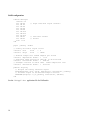
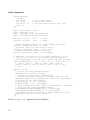
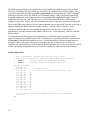
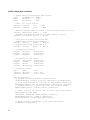
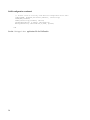
Solution: To improve the time resolution, the initial sample rate is boosted to about 20000 samples per
second on each channel – much faster than the final recorded data set requires. The timing signal is
analyzed by the IRIGSCAN command, which determines how to track the IRIG-B time base signal.
The data stream is then processed by the TBRESAMP command, producing blocks of signal data at a
partially-reduced 4000 samples per second rate aligned to the IRIG timing signal.
The intermediate rate is still much faster than what is needed for data recording. The AAMFILT
command is applied to avoid aliasing the captured noise as the data rate is reduced to the required 200
samples per second in each block, with the data blocks remaining aligned to the 1-second intervals
reported by the IRIG time base receiver.
17